






As AlzheimUr is gaining body one starts to realise how rich in complexities and possibilities the centre is evolving. Apart from its function of being a day-care and a centre of investigation that even includes a bank of brains, its research also situates itself in the art of the theatre. But how is that possible? Can a theatre performance really form part of the treatment, or help in understanding the Alzheimer illness?
The theatre has had an important role in society right from the days of the Greeks when it formed part of people’s lives, both general public and the politicians and not merely as a form of entertainment. In Greek theatre an Athenian dramatist was expected to be the teacher of the citizens, to have a message. It was equally his duty to entertain the masses and to provide men of his own mental level with food for thought. Political, religious and social issues were raised and discussed, things that concerned the citizens. In the context of AlzheimUr, it would therefore be interesting to see how play writers can entwine social and cultural issues into the narrative and thus give the patient an opportunity to make associations and recognise moments from his own memory. Committed to the manifold problems of the Alzheimer illness, theatre performances can surely support scientific research in looking for means to help the patient in confronting the changes in his life, and to guide families and doctors in solving moral problems. This would, however, be a great challenge recalling arguments from art therapies suggesting that when memory starts to fail, the Alzheimer patient can react easier to a painting that describes particular scenery as opposed to a film due to the time span that occurs in the narrative from the beginning to the end.
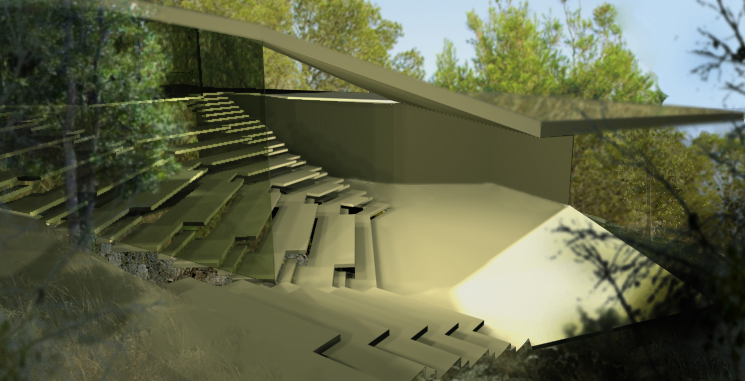
The situation of the theatre within the complex of AlzheimUr in the hills of Montecantalar is also important. Walking in the mountain recalls a number of characteristics from the city; of finding things, of sharing things. The warm climate of the Mediterranean encourages people to make social life in the squares; they organise y bump into lectures, informal talks, cinema, music and dance, exhibitions and workshops... Found along one of the pathways that embrace the mountain, the theatre is like the town square, a place one can pass through and go to. It is a complex place; culture is fostered, communication encouraged, knowledge and technology is set on display. The town square is a heterogeneous place and open, it welcomes changes and is, in that sense, optimistic. It is full of possibilities.
Going to the theatre and summer cinema is a social act that is called back in AlzheimUr, drawn from far back in memory. It is food for thought, as much as those baguettes with jamón and tortilla during the summer nights, when the patients went to watch a film which was interrupted by the sound of crickets and where the flowers of the bougainvilleas covered the walls of the open air cinema. They are memories that cannot be forgotten.
The theatre has had an important role in society right from the days of the Greeks when it formed part of people’s lives, both general public and the politicians and not merely as a form of entertainment. In Greek theatre an Athenian dramatist was expected to be the teacher of the citizens, to have a message. It was equally his duty to entertain the masses and to provide men of his own mental level with food for thought. Political, religious and social issues were raised and discussed, things that concerned the citizens. In the context of AlzheimUr, it would therefore be interesting to see how play writers can entwine social and cultural issues into the narrative and thus give the patient an opportunity to make associations and recognise moments from his own memory. Committed to the manifold problems of the Alzheimer illness, theatre performances can surely support scientific research in looking for means to help the patient in confronting the changes in his life, and to guide families and doctors in solving moral problems. This would, however, be a great challenge recalling arguments from art therapies suggesting that when memory starts to fail, the Alzheimer patient can react easier to a painting that describes particular scenery as opposed to a film due to the time span that occurs in the narrative from the beginning to the end.
The situation of the theatre within the complex of AlzheimUr in the hills of Montecantalar is also important. Walking in the mountain recalls a number of characteristics from the city; of finding things, of sharing things. The warm climate of the Mediterranean encourages people to make social life in the squares; they organise y bump into lectures, informal talks, cinema, music and dance, exhibitions and workshops... Found along one of the pathways that embrace the mountain, the theatre is like the town square, a place one can pass through and go to. It is a complex place; culture is fostered, communication encouraged, knowledge and technology is set on display. The town square is a heterogeneous place and open, it welcomes changes and is, in that sense, optimistic. It is full of possibilities.
Going to the theatre and summer cinema is a social act that is called back in AlzheimUr, drawn from far back in memory. It is food for thought, as much as those baguettes with jamón and tortilla during the summer nights, when the patients went to watch a film which was interrupted by the sound of crickets and where the flowers of the bougainvilleas covered the walls of the open air cinema. They are memories that cannot be forgotten.


