


Due to its role, the centre of dementia is a complex place. It is here where decisions are made, patients are observed and diagnosed and, families are listened to. But, it is as well, a place where different experts meet and exchange and share doubts, ideas and knowledge. The form of dialogue occupies therefore an important part of the day, that is, the TEAM work between families, neurologists, psychologists, neuropsychologists, social workers, geriatrists and nurses.
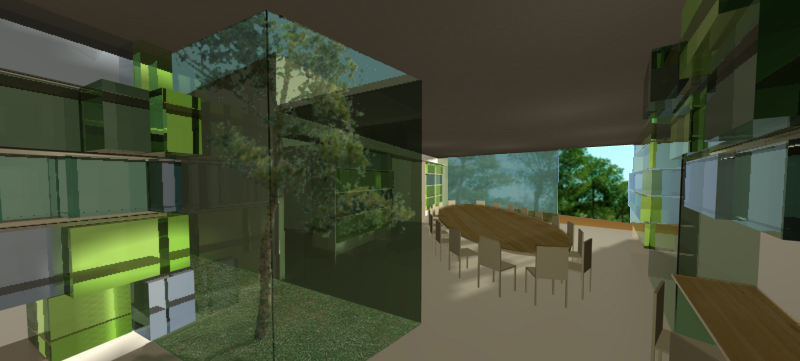
The typology of this unit shows the specialists’ offices branching out from the central space, which appears as a “street”. It is an internal spine where conversations takes place between professionals. The “street” is a meeting place, where the specialists bring news, construct arguments and provide support to each other. It is a place to read and contemplate, converse and debate. In order to adapt to diverse groups, the meeting tables are arranged along the “street”, different in sizes and intensities, accumulating a variety of experiences as part of the intense investigation that takes place in the whole of AlzheimUr. If once individual work was ever cherished, now group work and research teams are becoming the norm. It even incorporates the international scene as nowadays experts are no longer needed to be physically in the same place. New technologies have changed the way of working.
In the joint search for knowledge, this central space, or street, can be identified as a library, a physical space and an intellectual space where every single story can be found and told through a variety of resources. It is a place that encouraged experiences and where interaction is important in the forms of conversations and debates. The library, which was once a quiet place for individual study, has here become a scenario for dialogues and socialisation. But in contrast to the hectic life of a main street, the library is warm like a living room where hosts and guests engage in conversations and plants form part of the interior by allowing the exterior to enter through the balcony and through the internal courtyards. It is an enriched space which returns the specialists to their more private rooms where they receive patients and their families for more intimate talks in the consulting rooms. These rooms border the mountain so that the patients can walk along a green a balcony that embraces this unit of dementia. A green path that offers a rest and a theme for a conversation looking out towards the orchard while waiting or being close to pine trees that cut across the roof opening the view towards the sky.
The typology of this unit shows the specialists’ offices branching out from the central space, which appears as a “street”. It is an internal spine where conversations takes place between professionals. The “street” is a meeting place, where the specialists bring news, construct arguments and provide support to each other. It is a place to read and contemplate, converse and debate. In order to adapt to diverse groups, the meeting tables are arranged along the “street”, different in sizes and intensities, accumulating a variety of experiences as part of the intense investigation that takes place in the whole of AlzheimUr. If once individual work was ever cherished, now group work and research teams are becoming the norm. It even incorporates the international scene as nowadays experts are no longer needed to be physically in the same place. New technologies have changed the way of working.
In the joint search for knowledge, this central space, or street, can be identified as a library, a physical space and an intellectual space where every single story can be found and told through a variety of resources. It is a place that encouraged experiences and where interaction is important in the forms of conversations and debates. The library, which was once a quiet place for individual study, has here become a scenario for dialogues and socialisation. But in contrast to the hectic life of a main street, the library is warm like a living room where hosts and guests engage in conversations and plants form part of the interior by allowing the exterior to enter through the balcony and through the internal courtyards. It is an enriched space which returns the specialists to their more private rooms where they receive patients and their families for more intimate talks in the consulting rooms. These rooms border the mountain so that the patients can walk along a green a balcony that embraces this unit of dementia. A green path that offers a rest and a theme for a conversation looking out towards the orchard while waiting or being close to pine trees that cut across the roof opening the view towards the sky.


